


Today, Fort Samora Machel Special Forces Command (SFC) Training School undertakes a major environmental restoration exercise, with plans to plant assorted tree seedlings within its premises. The initiative reflects a growing commitment by the institution to promote sustainability, combat climate change, and contribute to Uganda’s broader efforts to restore degraded landscapes while instilling environmental stewardship among its trainees.
Located in Kaweweta, Nakaseke District, Fort Samora Machel SFC Training School is a key military training facility of the Uganda People’s Defence Forces, established to build the capacity of elite units tasked with specialized operations. Named after Samora Machel, a renowned liberation leader in Africa, the institution reflects a legacy of discipline, resilience, and Pan-African solidarity, notably including environmental conservation efforts like tree planting, aligning national security with sustainable development.
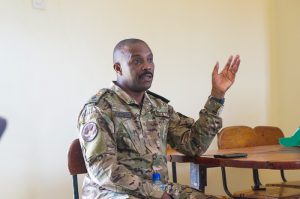
“My first time hearing about the protection of the environment was when the commander-in-chief, H.E. Yoweri Museveni, took over the leadership of this country. He advised that if you cut one tree, you have to replant at least three trees, and that is how he managed to maintain even the few trees we can see today,” said Lt Col Edison Beyendera, Commandant Fort Samora Machel Training School.
According to Lt Col Edison Beyendera, “By 1990,24% was Uganda’s Forest Cover,” but it has since declined to 13%, so there is a need to increase it to at least 30% of the land area covered by forests.
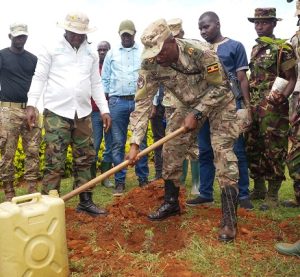 “By planting a tree, you are not making a mistake,” He noted, highlighting the critical role the environment plays even in military operations. “We, the personnel in uniform, consider the environment our best ally in everything we do, whether in training or combat. We often rely on natural cover for safety, and I only wish that all the deforested parts of the country were reafforested.” In his concluding remarks, Mr. Beyendera shared his deep personal appreciation for natural environments, noting that he enjoys staying in areas rich with trees and fresh air.
He observed that such surroundings reflect the harmony of God’s creation, moving as intended.
On behalf of the leadership of the Special Forces Command and the Uganda People’s Defence Forces at large, he expressed sincere gratitude to the visitors coordinated by Dr Jibril Semakura Owomugisha for their generous support in providing tree seedlings to green Fort Samora Machel. He added that by the close of the year, anyone visiting from outside the quarter guard would witness a remarkable transformation, with large sections of the area now covered by trees that were previously absent.
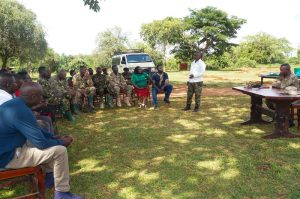
Through the flagship of the Running Out of Trees (ROOTs) Campaign, Roofings Uganda donated a total of 3,000 assorted tree seedlings, including fruit trees such as mangoes, jackfruits, and avocados, as well as other species like grevillea. Of these, over 50 seedlings were ceremoniously planted on that day.
“Aerial surveillance becomes so easy in an open space compared to forested lands. Tree Planting will not only help us to improve our security, but also enable us to improve food security within all Barracks,” said Dr Jibril Semakura Owomugisha, the event coordinator.
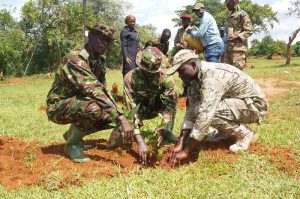
This initiative builds on earlier efforts, including a similar tree planting exercise first undertaken in June last year at Buyala Military Barracks, reflecting a growing commitment to environmental restoration within military establishments, to which the Ministry of Water and Environment, Million Trees International, Environmental Alert, Roofings Group Ltd, Buganda kingdom, Every Birthday Tree Day Initiative, Mwiri Old Boys Association and other ROOTs partners pledged to attend.
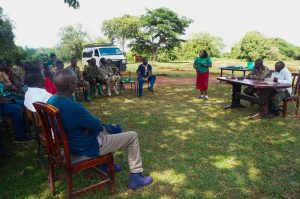
“On behalf of the ROOTs Secretariat and the ROOTs Family, we appreciate and thank the leadership of SFC Fort Samora Machel Training School for hosting us today and for joining and contributing to the ROOTs Campaign to plant trees,” said the Team Leader at Environmental Alert (ROOTs Secretariat), Jacinta Nekesa.
According to Jacinta, the ROOTs Campaign is more than just an initiative; it is a movement driven by people and dedicated to planting seeds of hope for future generations. She emphasized that the campaign focuses on restoring ecosystems through the planting of indigenous trees, including fruit-bearing species.
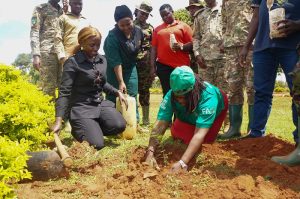 “It is one thing to plant trees, but another to grow them,” she noted, urging the leadership and administration of Fort Samora Machel Training School to take responsibility for nurturing the trees planted during the exercise to ensure their survival and long-term growth. She further highlighted ROOTs’ broader vision: a future where forests flourish, ecosystems thrive, and communities become more resilient to the effects of environmental degradation and climate change.
